

 中
中 英
英



Reciprocating Actuator for Engine Governor and Fuel Rack Control
News and Exhibitions
2026.08.21


Reliable standby power depends on accurate utility monitoring, timely fault detection, and coordinated switching between the utility supply and a generator. A generator controller brings these functions together, helping industrial facilities, commercial buildings, and critical infrastructure respond to changes in electrical conditions. Fortrust Power Electric provides generator control solutions designed to support different phase configurations, real-time electrical monitoring, remote operation, and flexible integration with external equipment.
Utility power abnormalities can interrupt operations and affect connected electrical equipment. A generator controller helps identify conditions such as overvoltage, undervoltage, and phase loss, allowing the control logic to respond when monitored values fall outside configured limits. When connected to compatible transfer equipment, it coordinates the transition between utility power and generator supply according to the configured operating sequence.
Automatic utility detection and transfer control are particularly valuable in facilities where power interruptions require a timely response. By combining electrical condition monitoring with coordinated switching, the controller reduces reliance on manual operation and helps support a more consistent standby power process. Correct configuration and compatibility with the generator and transfer equipment remain essential for safe operation.
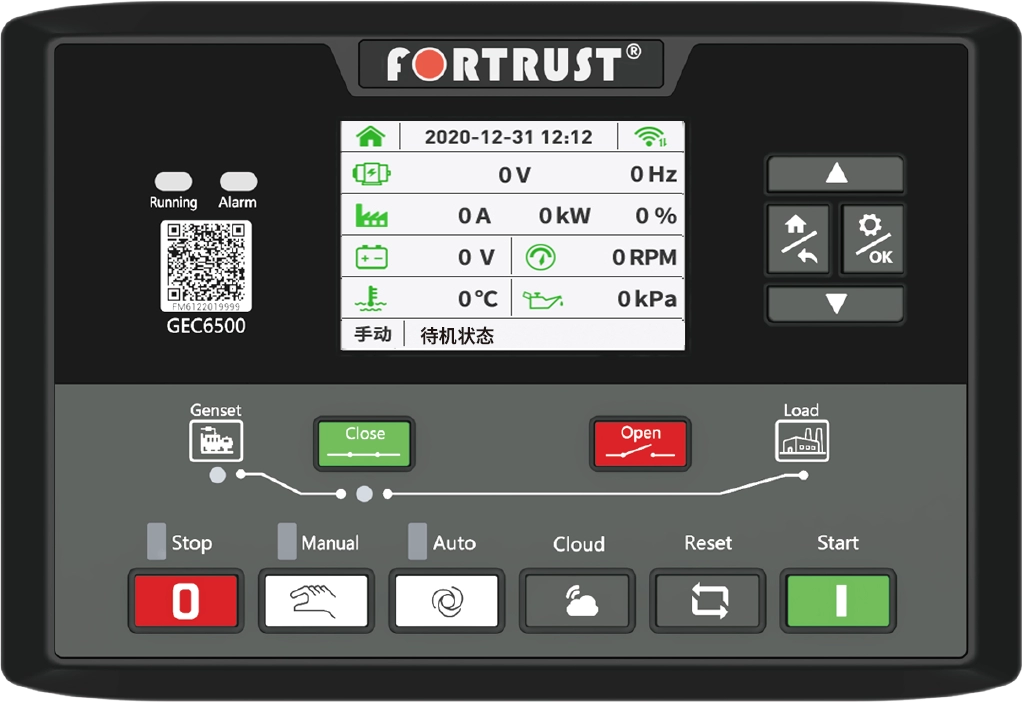
Electrical installations differ in voltage, wiring, and load requirements. A versatile generator controller can support single-phase two-wire, split-phase three-wire 120/240 V, and three-phase four-wire configurations, allowing it to serve a range of standby power applications. This flexibility is useful for equipment manufacturers and project engineers who need to accommodate different electrical arrangements without overlooking monitoring requirements.
Before selecting a controller, engineers should confirm the supply configuration, voltage sensing connections, and compatibility with the intended generator and transfer equipment. Matching these requirements helps ensure that single-phase and three-phase utility detection functions correctly and that electrical measurements can be interpreted accurately.
A generator controller provides operators with essential information about electrical performance, including three-phase voltage, current, frequency, and power factor. These measurements help maintenance personnel assess operating conditions and identify abnormal readings that may require investigation. Rather than relying solely on basic generator start and stop functions, operators can use the displayed information to make better-informed maintenance and operating decisions.
Monitoring multiple electrical parameters also helps improve visibility into generator performance during standby operation. Real-time generator electrical monitoring is especially useful in industrial facilities, data centers, hospitals, and telecommunications installations, where maintenance teams need clear information to evaluate power conditions and respond to alarms.
Remote access can make generator operation more convenient when personnel need to monitor equipment from a location away from the control panel. With a built-in Wi-Fi module and compatible mobile application, supported functions can include remote start and stop commands, parameter configuration, and diagnostic checks. These capabilities allow authorized users to access relevant control information without requiring every adjustment or inspection to take place locally.
For facilities managing distributed equipment or limited on-site staffing, Wi-Fi-enabled generator controller monitoring can improve operational accessibility. Remote functions should be configured carefully, with appropriate user permissions and operating procedures, to ensure that convenience does not compromise safe equipment handling.
An intuitive operator interface helps maintenance personnel review readings, check operating status, and navigate configuration options. A color LCD with Chinese and English language support makes the controller more accessible to users in different working environments. Clear presentation of electrical measurements and status information can also simplify routine inspections and troubleshooting.
Integration flexibility is another important consideration. Multiple programmable relay outputs, together with analog and digital input ports, allow the controller to accommodate different external signals and control requirements within its supported capabilities. These interfaces can help engineers coordinate the controller with compatible equipment while adapting the installation to the project's functional needs.
A generator controller with utility detection, electrical monitoring, and automatic transfer coordination can serve a wide range of standby power applications. In manufacturing facilities, it supports backup power arrangements for production-related operations. Data centers can use suitable generator control solutions as part of their emergency power arrangements, while hospitals and medical facilities can incorporate them into appropriately engineered standby power installations.
Commercial buildings, smart infrastructure projects, telecommunications base stations, and networking facilities may also benefit from dependable monitoring and control. The appropriate configuration depends on each site's electrical design, load requirements, transfer equipment, and operational procedures. Selecting the right controller therefore requires evaluating the complete application rather than relying on individual features alone.
Fortrust Power Electric combines electrical monitoring, utility fault detection, automatic transfer coordination, and remote management capabilities in its generator control offerings. Its multilingual interface supports convenient operation, while programmable inputs and outputs provide flexibility for different integration requirements. For equipment manufacturers and project developers, OEM and ODM customization can also help address specific application and configuration needs.
When evaluating a generator controller, buyers should prioritize compatibility with the electrical installation, the required protection and monitoring functions, communication options, and the demands of the intended application. By considering these factors together, businesses can select a control solution that supports dependable standby power management and practical day-to-day operation.
Key functions include utility voltage monitoring, overvoltage and undervoltage detection, phase-loss detection, generator electrical monitoring, and coordination with compatible automatic transfer equipment. Remote access and programmable interfaces may provide additional flexibility.
Certain controllers support single-phase two-wire, split-phase three-wire 120/240 V, and three-phase four-wire installations. The supported configurations and voltage requirements should be verified against the manufacturer's specifications.
Depending on its capabilities, a controller can monitor voltage, current, frequency, and power factor. These readings help operators assess electrical conditions and investigate abnormal performance.
Wi-Fi connectivity and a compatible mobile application can enable supported remote functions, including start and stop commands, parameter configuration, and diagnostics. Access permissions and safe operating procedures should be established before remote operation is enabled.
Yes. Depending on its specifications and installation requirements, a suitable controller can be integrated into standby power arrangements for manufacturing facilities, data centers, hospitals, commercial buildings, and telecommunications infrastructure.
![[Uniting for a Shared Future: Shipbuilding and Marine Engineering] Fuchuang Power Hosts and Deeply Participates in the Establishment of the Harbin Engineering University Alumni Shipbuilding and Marine Engineering Industry Alliance in Nantong](/uploads/upload/20260316/2603161FPGF.webp)