

 中
中 英
英



Visit Fortrust at Middle East Energy Dubai 2026
News and Exhibitions
2026.08.31


Engine speed depends heavily on how accurately fuel delivery can be adjusted under changing operating conditions. When the fuel pump rack needs controlled movement, the actuator becomes the link between the electronic governor and the mechanical fuel control mechanism. A reciprocating actuator converts an electrical control signal into controlled linear movement, allowing the fuel rack position to be adjusted according to the required engine output.
This approach is particularly valuable where stable speed, responsive load control, and consistent fuel regulation are important. Instead of relying solely on mechanical adjustment, an electronically controlled actuator can respond continuously to governor commands. The result is more predictable fuel rack positioning and improved coordination between the engine governor and fuel delivery mechanism.
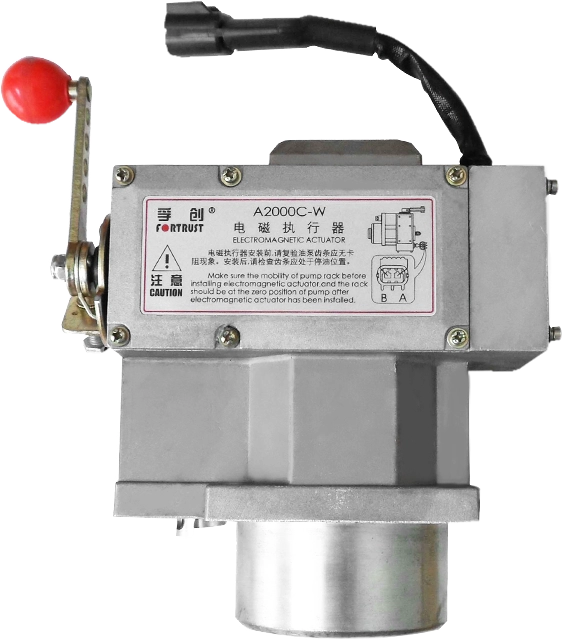
The operating principle is straightforward but requires precise mechanical and electrical coordination. The electronic governor sends a regulated current to the actuator, and the actuator produces a corresponding movement at its output shaft. This movement is transferred to the fuel pump rack, changing its position and therefore adjusting the amount of fuel supplied to the engine.
The relationship between electrical input and mechanical displacement is important for accurate control. A well-matched engine governor actuator should provide consistent movement throughout its working range while responding quickly enough to compensate for changes in engine load. Stable output characteristics also help reduce unnecessary fluctuations in engine speed.
The actuator does not work independently. Its performance depends on the relationship between the governor output, actuator response, mechanical linkage, and fuel pump characteristics. For this reason, selecting a fuel rack actuator requires consideration of both electrical compatibility and the required mechanical stroke.
The output movement must correspond correctly with the fuel pump rack direction and available travel. If the actuator is poorly matched to the fuel control mechanism, excessive movement, insufficient travel, delayed response, or unstable regulation may occur. Proper integration therefore matters as much as the actuator itself.
Choosing a suitable reciprocating actuator for engine control involves more than checking whether the device can move the fuel rack. The operating voltage, available force, working stroke, current requirement, installation arrangement, temperature conditions, and mechanical connection should all be considered together.
The actuator should also provide sufficient reserve capability for the actual fuel rack load. A unit operating continuously near its maximum capacity may experience unnecessary thermal stress and reduced response consistency. On the other hand, excessive actuator capacity can make mechanical integration less efficient and may complicate control calibration.
| Selection Factor | Why It Matters |
|---|---|
| Operating voltage | Must match the governor output and electrical architecture |
| Working stroke | Determines the available fuel rack movement |
| Output force | Ensures sufficient movement under mechanical load |
| Response characteristics | Affects speed regulation and load response |
| Temperature range | Supports stable operation under changing conditions |
| Mechanical connection | Determines installation compatibility |
| Position feedback | Can support more precise control where required |
Fuel rack position directly influences fuel delivery, so uncontrolled movement can affect engine behavior. A fuel pump rack control actuator should provide repeatable displacement and maintain stable positioning as the governor changes its command. Consistent movement is especially important when the engine experiences frequent changes in load.
Mechanical linkage should be designed with appropriate alignment and minimal unnecessary resistance. Friction, binding, excessive clearance, or incorrect linkage geometry can reduce the effective accuracy of the actuator even when its electrical performance is satisfactory. Installation quality is therefore an essential part of achieving reliable fuel rack control.
Fast response alone does not guarantee effective engine control. The actuator needs to respond quickly while avoiding unnecessary oscillation or overshoot. The governor, actuator, linkage, and fuel pump must work together as a coordinated control chain.
A properly selected electronic speed control actuator can help maintain a more consistent relationship between the governor command and fuel rack position. This supports smoother adjustment during acceleration, deceleration, and changing load conditions while reducing the possibility of erratic fuel movement caused by an unsuitable actuator response.
Temperature is another important factor in actuator selection. Engine compartments can expose electrical and mechanical components to significant temperature changes, so the actuator must maintain suitable operating characteristics across the intended temperature range. Electrical resistance, mechanical clearances, and material behavior can all influence performance under different conditions.
Installation should also account for the actuator's movement direction, stroke, mounting arrangement, and connection to the fuel pump rack. The output shaft should move freely without excessive side loading. Correct alignment helps reduce mechanical resistance and supports consistent operation over the service life of the equipment.
Some engine control applications can benefit from position feedback. A feedback-equipped actuator provides additional information about the actual position of the output mechanism, allowing the control circuit to compare commanded movement with physical movement.
This can be useful where accurate fuel rack position control is a priority. However, feedback should be selected according to the requirements of the complete control arrangement rather than added simply as an extra feature. Compatibility between the feedback signal, governor, wiring, and control logic must be confirmed during selection.
A reciprocating actuator for fuel control can be used in applications where an electronic command must be converted into controlled mechanical movement. Engine governors, fuel pump mechanisms, generator equipment, and other electronically regulated engine applications can require this type of actuation.
The main value lies in its ability to provide controlled linear movement within a defined operating range. This makes it suitable for applications where direct mechanical positioning is needed and where the actuator must operate as part of a coordinated engine control arrangement.
A high-quality actuator cannot compensate for an incorrect overall configuration. The governor output, actuator characteristics, fuel pump rack travel, linkage geometry, and engine operating requirements must be evaluated as a complete combination.
Fortrust focuses on actuator products designed for engine control applications, with attention to electrical compatibility, mechanical movement, operating conditions, and practical installation requirements. When selecting a reciprocating actuator, engineers should evaluate the complete operating environment rather than choosing solely according to nominal voltage or output capacity.
A reciprocating actuator converts an electrical control signal into controlled linear movement. In engine applications, this movement can be connected to a fuel pump rack to regulate fuel delivery according to commands from an electronic governor.
The governor regulates the actuator's electrical input according to the desired engine speed and operating conditions. The actuator then moves its output shaft, which changes the fuel rack position and adjusts fuel delivery.
Key considerations include operating voltage, working stroke, output force, current requirement, temperature range, mounting method, linkage geometry, and whether position feedback is required. Mechanical and electrical compatibility should be evaluated together.
The actuator must respond accurately to changing governor commands. Appropriate response characteristics help the fuel rack follow the required position without excessive delay, instability, or unnecessary movement.
Yes. The appropriate actuator can be selected according to the engine control arrangement, fuel pump mechanism, required rack travel, electrical input, and mechanical load. Proper matching is essential for reliable performance.
Fortrust develops actuator products for engine control applications with consideration for precise mechanical movement, electrical compatibility, operating conditions, and integration with fuel control mechanisms. The selection should be based on the specific requirements of the intended engine and governor arrangement.