

 中
中 英
英



Intelligent Emergency Protection & Power Safeguard: Fortrust
Company News
2026.05.11


Stable engine speed is fundamental to consistent generator set performance. When operating conditions change, variations in load can cause engine speed to rise or fall, affecting output stability and overall operating efficiency. An electronic engine speed controller addresses this challenge by continuously detecting speed changes and converting them into electronic signals for precise control.
Unlike basic mechanical regulation methods, an electronic governor can respond rapidly to changing operating conditions. The controller compares the detected speed signal with a preset reference value and sends a corresponding output signal to the actuator. The actuator then adjusts the fuel supply mechanism, allowing the engine to return quickly toward the required operating speed.
This closed-loop approach makes the controller particularly valuable where precise genset speed control is required. Rather than relying on a fixed response, the controller continuously corrects speed according to actual operating conditions, helping maintain stable performance during acceleration, load variation, and normal operation.
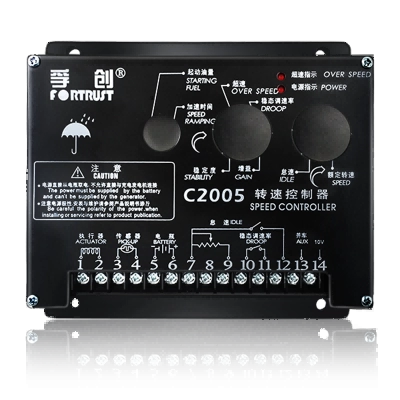
The operating principle of a single closed-loop electronic speed controller is based on continuous feedback. Speed and load changes are transmitted as electronic signals to the control unit, where the incoming signal is compared with a preset voltage or current reference. The resulting control signal is then delivered to the actuator.
The actuator responds mechanically by adjusting the fuel supply rack. When additional fuel is required, the actuator increases fuel delivery; when less fuel is required, it reduces the supply. This rapid adjustment helps maintain the target engine speed without relying on manual intervention.
For generator applications, this feedback process is important because operating conditions rarely remain completely constant. A well-adjusted engine speed controller for generator sets can provide smoother speed correction and help reduce unnecessary fluctuations during changing loads.
An electronic governor needs to do more than simply maintain a target speed. Different stages of engine operation require different control characteristics, particularly during starting, acceleration, rated operation, and abnormal speed conditions.
| Control Function | Operating Value |
|---|---|
| Speed fine-tuning | Supports accurate speed adjustment and remote control |
| Starting fuel adjustment | Helps manage exhaust smoke during startup |
| Acceleration adjustment | Controls the transition from idle to rated operation |
| Overspeed protection | Provides a defined speed limit and shutdown response |
| High and low speed switching | Supports idle and rated-speed selection |
| Parallel operation | Allows coordinated operation of multiple units |
| Full-range regulation | Enables smooth speed adjustment across the operating range |
These functions allow the controller to adapt to different operating requirements instead of applying the same response under every condition. For operators and equipment manufacturers, this flexibility can simplify commissioning and provide more consistent control behavior.
Overspeed is one of the most important conditions that an electronic governor must address. If engine speed rises beyond the permitted range, continued operation can place excessive mechanical stress on rotating components. An electronic engine speed controller with overspeed protection can be configured with an appropriate speed limit.
When the detected speed reaches the defined overspeed threshold, the controller can cut actuator power and initiate engine shutdown. This provides an additional protective function alongside normal speed regulation and helps prevent uncontrolled speed increases.
Automatic stop protection also applies when the speed signal disappears or when controller power is lost. These protective responses are especially important for generator sets that need dependable operation with limited operator intervention.
Load variation presents a practical challenge for generator set speed control. When electrical demand changes, the engine must respond quickly enough to maintain the required operating speed. Poorly adjusted control can result in excessive speed fluctuation, slow recovery, or unstable operation.
A closed-loop engine speed controller continuously evaluates the difference between actual speed and the target value. This enables the actuator to make corresponding fuel adjustments and restore the desired speed more efficiently.
The controller supports a speed fluctuation rate of ≤ ±0.25%, while the steady-state speed regulation rate can be adjusted from 0 to 5%. These characteristics provide useful flexibility when configuring engine speed control for different generator applications.
Acceleration from idle to rated operating conditions requires controlled fuel delivery. Excessively rapid fuel increase can contribute to unwanted exhaust smoke and unstable acceleration, while an overly slow response can reduce operational efficiency.
An electronic governor controller for generator applications can provide adjustable acceleration time, allowing the transition to be matched to the operating requirements of the engine and generator set. Starting fuel quantity can also be adjusted to help control exhaust smoke during startup.
This combination of starting fuel adjustment and acceleration control provides greater control over engine behavior during one of the most sensitive stages of operation.
Generator sets may need to operate individually or together depending on the required power output. The parallel operation function supports multiple-unit operation and can provide both manual and automatic parallel control options.
Full-range speed regulation further improves flexibility by allowing continuous and smooth adjustment within the applicable speed range. This is useful when different operating conditions require changes to the target speed or when commissioning personnel need to fine-tune the governor response.
For equipment manufacturers and integrators, these functions make an electronic speed controller for genset applications more adaptable to different control requirements without adding unnecessary complexity to the operating process.
Industrial engine control equipment may be exposed to significant temperature and humidity changes. The controller is designed for an ambient temperature range of -40°C to +85°C and ambient humidity below 95%, providing a broad operating range for demanding installation environments.
The controller can operate with either a DC 24V supply from 18V to 32V or a DC 12V supply from 9V to 16V. Its power consumption is below 0.2A, excluding the actuator. These electrical characteristics should be considered during equipment integration to ensure the control circuit and actuator are correctly matched.
The value of an electronic engine speed controller lies in the combination of precise regulation, rapid response, adjustable operating parameters, and protective functions. Instead of treating speed control as a single fixed adjustment, an electronic governor manages several operating conditions through feedback and configurable control functions.
For generator set manufacturers, integrators, and maintenance teams, this approach can support more predictable engine behavior and simplify speed adjustment during commissioning. Careful configuration of speed regulation, acceleration time, starting fuel, and overspeed limits is essential to achieving the desired operating characteristics.
Fortrust provides electronic speed control solutions designed around these practical requirements, combining closed-loop speed regulation with adjustable control and protection functions for generator set applications.
An electronic engine speed controller receives speed-related signals, compares them with a preset reference, and sends a control signal to the actuator. The actuator then adjusts fuel delivery to maintain the required engine speed.
Closed-loop control continuously compares actual engine speed with the target value. This allows the controller to respond to changing operating conditions and provides more precise speed regulation than a fixed adjustment approach.
Yes. An appropriately configured controller can establish an overspeed limit and respond by cutting actuator power and stopping the engine when the defined threshold is reached.
The controller provides a parallel operation function for multiple units, with options for manual and automatic parallel operation.
The specified ambient operating temperature range is -40°C to +85°C, with ambient humidity below 95%.
The controller supports either DC 24V with an 18V–32V range or DC 12V with a 9V–16V range, with power consumption below 0.2A excluding the actuator.