

 中
 英




Marine Control Box Solutions for Ship Engine Monitoring and Control
News and Exhibitions
2026.08.06


Industrial equipment is often installed across remote sites, distributed facilities, and locations where direct network access is limited. Without reliable communication, operators may need to depend on manual inspections to obtain operating information, identify equipment abnormalities, or confirm device status. An industrial gateway with 4G connectivity helps address these challenges by transmitting equipment data to remote monitoring platforms through cellular networks, making equipment information accessible without requiring a fixed wired internet connection at every installation site.
For industrial applications, an industrial IoT gateway does more than provide network access. It connects field controllers, collects operating information, and transfers data between local equipment and remote management platforms. This approach helps improve equipment visibility, simplify maintenance coordination, and reduce the time required to obtain operational information from geographically separated assets.
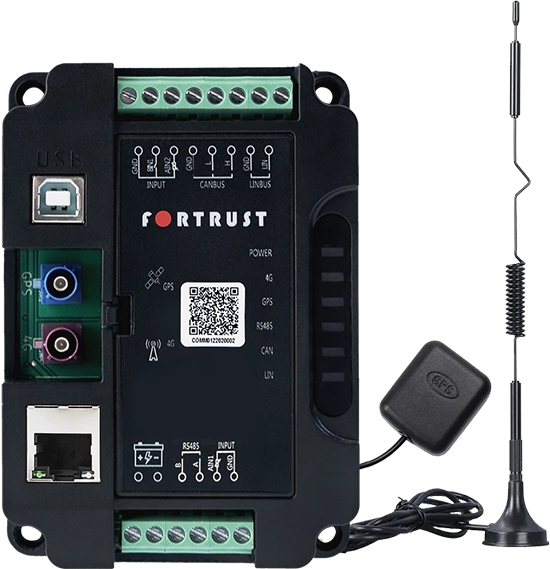
Industrial equipment uses different communication interfaces depending on its control architecture and application requirements. A suitable industrial gateway should therefore support multiple connection methods to accommodate different devices without requiring extensive modifications to existing wiring arrangements.
With 4G, 2G, 3G, Ethernet, RS485, and CAN communication, an industrial gateway can support connections between compatible controllers and remote monitoring platforms. RS485 and CAN interfaces provide communication channels for industrial control equipment, while Ethernet offers another option for network connectivity. Cellular communication allows collected information to be transmitted when conventional wired connections are unavailable.
Communication Interface | Main Application |
|---|---|
2G / 3G / 4G | Cellular data transmission |
Ethernet | Wired network connectivity |
RS485 | Industrial controller communication |
CAN | Equipment data communication |
GPS / BeiDou | Equipment positioning |
The availability of multiple interfaces makes industrial gateway connectivity particularly useful for equipment manufacturers and integrators working with different controller configurations. However, interface availability alone does not guarantee compatibility. Communication protocols, wiring arrangements, and controller support should be verified before installation.
Diesel generator sets require continuous attention to operating conditions, particularly when they supply power to facilities that cannot tolerate unexpected interruptions. Checking every generator manually can increase maintenance workloads, especially when equipment is installed at multiple locations. A 4G industrial gateway for generator monitoring provides a communication link between compatible generator controllers and remote monitoring platforms.
Through this connection, users can access equipment operating information, review historical records, and monitor relevant operating conditions from computers or mobile devices. Remote data access helps maintenance personnel understand equipment status before arranging site inspections. It can also support more efficient fault assessment by providing operational information for preliminary troubleshooting.
For generator manufacturers, rental equipment operators, and power equipment service providers, remote diesel generator monitoring offers a practical way to manage distributed equipment. The gateway acts as a communication bridge, while the connected controller remains responsible for the supported generator control functions.
Equipment location is another important consideration when managing mobile or geographically distributed industrial assets. Knowing where a generator or other connected device is installed helps operators organize maintenance activities, manage equipment allocation, and improve asset visibility.
An industrial gateway with GPS tracking can transmit positioning information, including longitude, latitude, and altitude, through its communication connection. Support for both GPS and BeiDou positioning provides additional flexibility for location-based equipment management. Electronic fence functionality can also help users monitor whether connected assets remain within designated geographical boundaries, subject to the configured platform and application requirements.
These capabilities are particularly relevant to generator rental businesses and equipment operators responsible for assets deployed across different work sites. Combining positioning information with operating records makes it easier to associate equipment status with its physical location.
Remote equipment management should extend beyond basic data transmission. Maintenance teams may also need to adjust supported parameters, perform remote operations, or update device programs without arranging unnecessary site visits. A capable industrial IoT gateway for remote monitoring can facilitate these activities when connected to compatible controllers and authorized cloud services.
Depending on the connected controller and application configuration, remote functions may include parameter modification, equipment control, and program upgrades. These capabilities can simplify certain maintenance procedures and reduce the effort involved in managing geographically separated equipment.
At the same time, remote access requires appropriate authorization and communication configuration. Equipment manufacturers should verify supported functions, access permissions, and operational procedures before enabling remote control. Separating monitoring access from control permissions can also help establish more appropriate equipment management practices.
Industrial equipment performance can be affected by conditions beyond the primary machine itself. Generator rooms, for example, may contain access control devices, security equipment, and fire protection facilities that require additional monitoring. An industrial gateway with auxiliary alarm inputs can help collect relevant signals and transmit them to a remote monitoring platform.
This capability expands the application of an industrial gateway for remote equipment management beyond generator operating data. By integrating supported external signals, users can obtain a broader view of equipment room conditions and receive information about connected auxiliary facilities. The actual monitoring scope depends on available inputs, wiring configuration, and the connected monitoring platform.
Choosing an industrial gateway requires evaluating the communication requirements of the connected equipment rather than focusing exclusively on cellular connectivity. Buyers should check whether the gateway supports the required interfaces, operating voltage, environmental conditions, and remote management functions.
Selection Factor | Important Considerations |
|---|---|
Network connectivity | 4G coverage and available network options |
Communication interfaces | RS485, CAN, and Ethernet compatibility |
Positioning | GPS and BeiDou support |
Power supply | DC voltage compatibility |
Remote functions | Monitoring, parameter updates, and control |
Environment | Operating temperature and humidity |
Installation | DIN rail or screw mounting |
Power consumption and installation conditions also deserve attention. Industrial equipment may operate continuously, making stable power input and suitable environmental performance important selection factors. Buyers should additionally confirm whether the gateway is compatible with the controller communication protocol and remote platform they intend to use.
Fortrust Power provides industrial connectivity solutions designed to support remote monitoring and equipment management applications. Its industrial IoT gateway combines cellular communication with Ethernet, RS485, and CAN interfaces, providing flexible connection options for compatible industrial controllers.
Additional capabilities include GPS and BeiDou positioning, remote data access, parameter modification, and program upgrades when used with supported controllers and platforms. Its DC 9–32V power input, operating temperature range of -25°C to +70°C, and DIN rail or screw mounting options support integration into different industrial installation environments.
For generator manufacturers, equipment integrators, and industrial operators, selecting an industrial gateway for remote equipment monitoring means considering the complete connection between field equipment, communication interfaces, and remote management requirements. Fortrust Power focuses on bringing these elements together to support more accessible equipment information and efficient remote maintenance.
An industrial gateway with 4G connectivity connects compatible industrial equipment to remote monitoring platforms through cellular networks, enabling data transmission and remote equipment access.
Yes. When connected to compatible generator controllers, it can transmit operating information and historical records for remote monitoring through supported platforms.
Common interfaces include RS485, CAN, and Ethernet. The appropriate combination depends on the connected equipment and communication requirements.
Dual positioning support provides equipment location information, helping operators manage distributed assets and implement location-based monitoring functions.
Yes. Remote parameter modification is available with compatible controllers and authorized monitoring platforms, depending on the supported configuration.
Power generation, industrial equipment manufacturing, equipment rental, remote facility management, and other sectors involving geographically distributed machinery can benefit from industrial gateway connectivity.