Electric Fire Pump Controller for Industrial Fire Protection Systems
An electric fire pump controller is a core control component in industrial fire protection infrastructure, responsible for coordinating the operation of fire water pump units under both standby and emergency conditions. It ensures that pump systems respond accurately to pressure changes, alarm signals, and operational demands, maintaining stable water supply performance when it matters most.
Unlike basic switching devices, modern controllers integrate measurement, communication, logic decision-making, and fault protection into a single compact unit. This enables fire pump systems to operate with higher precision and reduced dependency on manual intervention, especially in complex industrial environments where response time is critical.
Control Logic and Automatic Operation in Electric Fire Pump Controller
The operational logic of an electric fire pump controller is built around continuous monitoring and automatic response. When pipeline pressure drops below a defined threshold, the controller immediately initiates pump start-up procedures. Once pressure stabilizes, it manages shutdown based on system feedback, preventing unnecessary wear and energy waste.
The embedded 32-bit microprocessor enhances processing speed and ensures that multiple signals can be evaluated simultaneously. This allows the controller to handle not only start/stop commands but also timing functions, threshold comparisons, and safety interlocks.
Key operational behaviors include:
Automatic pump activation based on pressure detection
Controlled shutdown after system stabilization
Real-time evaluation of electrical and mechanical signals
Fault-triggered protection and alarm output
This structured logic significantly improves operational reliability in high-risk fire protection environments.
Data Monitoring and Multi-Parameter Measurement Functions
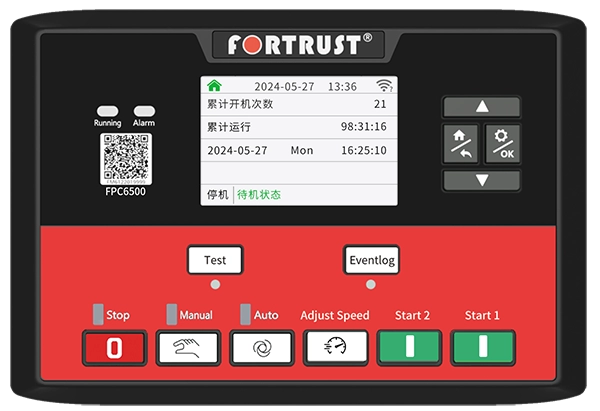
A critical advantage of an electric fire pump controller for industrial applications is its ability to continuously measure and display operating parameters. These include pump pressure, engine status, voltage conditions, and alarm states.
The system presents all data on a large LCD interface, designed for clarity under real-time operation conditions. The screen supports bilingual display, allowing operators in different regions to interpret data without miscommunication.
The monitoring framework includes:
| Monitoring Category | Function Description |
|---|
| Pressure Tracking | Real-time pipeline pressure feedback |
| Pump Status | Running, standby, fault indication |
| Electrical Signals | Voltage and control signal monitoring |
| Alarm Events | Immediate fault detection and notification |
This level of transparency helps operators make informed maintenance and operational decisions without delay.
Communication Interfaces and Remote Access Capability
Modern fire protection environments require connectivity beyond local control panels. The controller integrates multiple communication interfaces, including CANBUS (SAE J1939), RS485, USB, and Wi-Fi connectivity, enabling flexible integration with different pump configurations.
Through these channels, the controller can interact with electronically controlled engines as well as traditional mechanical pump systems. This compatibility ensures broader applicability across industrial fire safety projects.
Remote functions include:
Real-time curve viewing for performance analysis
Remote calibration and parameter adjustment
Fault diagnosis through data history review
Secure access via Wi-Fi-based connection tools
These capabilities reduce on-site maintenance frequency and improve diagnostic efficiency for technical teams.
Human-Machine Interface and Operational Usability
The interface design of the controller prioritizes operational clarity. A large LCD display provides structured visualization of key parameters, ensuring that operators can quickly assess system status without navigating complex menus.
Instead of overloaded displays, information is organized into functional sections that separate pump status, alarm messages, and measurement data. This design reduces operational errors and improves response speed during emergency conditions.
The bilingual interface further enhances usability in global industrial environments where multilingual operation is required.
System Protection and Alarm Management Logic
The controller incorporates a multi-layer alarm protection mechanism designed to respond to abnormal conditions in real time. When irregular signals are detected, the system immediately triggers alerts and records fault data for analysis.
Protection functions typically include:
Overpressure and underpressure detection
Pump failure identification
Sensor signal interruption alerts
Communication error warnings
By combining real-time detection with automated response logic, the controller ensures that fire pump units remain within safe operational boundaries at all times.
Engineering Structure and Installation Efficiency
From a structural perspective, the controller is designed with compact architecture and simplified wiring layout. This reduces installation complexity and allows faster deployment in pump rooms or control cabinets.
The modular design also supports easier maintenance, as individual interfaces and communication modules can be accessed without disrupting the entire control setup. This contributes to lower long-term maintenance costs and improved service efficiency.
Operational Advantages in Industrial Fire Protection Environments
In industrial fire protection scenarios, reliability and response speed are essential. An electric fire pump controller ensures that pump activation is not delayed by manual intervention, while also maintaining continuous monitoring of system health.
Its combination of automation, communication capability, and diagnostic functions makes it suitable for demanding environments where fire safety compliance and operational stability are required simultaneously.
FAQ
Q1: What is the main role of an electric fire pump controller?
It manages automatic operation, monitoring, and protection of fire pump units in fire protection applications.
Q2: Can it work with different types of pump engines?
Yes, it supports both electronically controlled and traditional pump engines through CANBUS and other interfaces.
Q3: Does it support remote monitoring?
Yes, Wi-Fi and wired communication allow remote data access, diagnostics, and parameter adjustment.
Q4: What information can be displayed on the controller?
It shows pressure data, pump status, electrical conditions, and alarm information in real time.
Q5: Is it suitable for industrial environments?
Yes, it is designed specifically for industrial fire protection systems requiring stable and reliable control performance.



 中
中 英
英





![[Uniting for a Shared Future: Shipbuilding and Marine Engineering] Fuchuang Power Hosts and Deeply Participates in the Establishment of the Harbin Engineering University Alumni Shipbuilding and Marine Engineering Industry Alliance in Nantong](/uploads/upload/20260316/2603161FPGF.webp)