Industrial Control Integrated Architecture Design
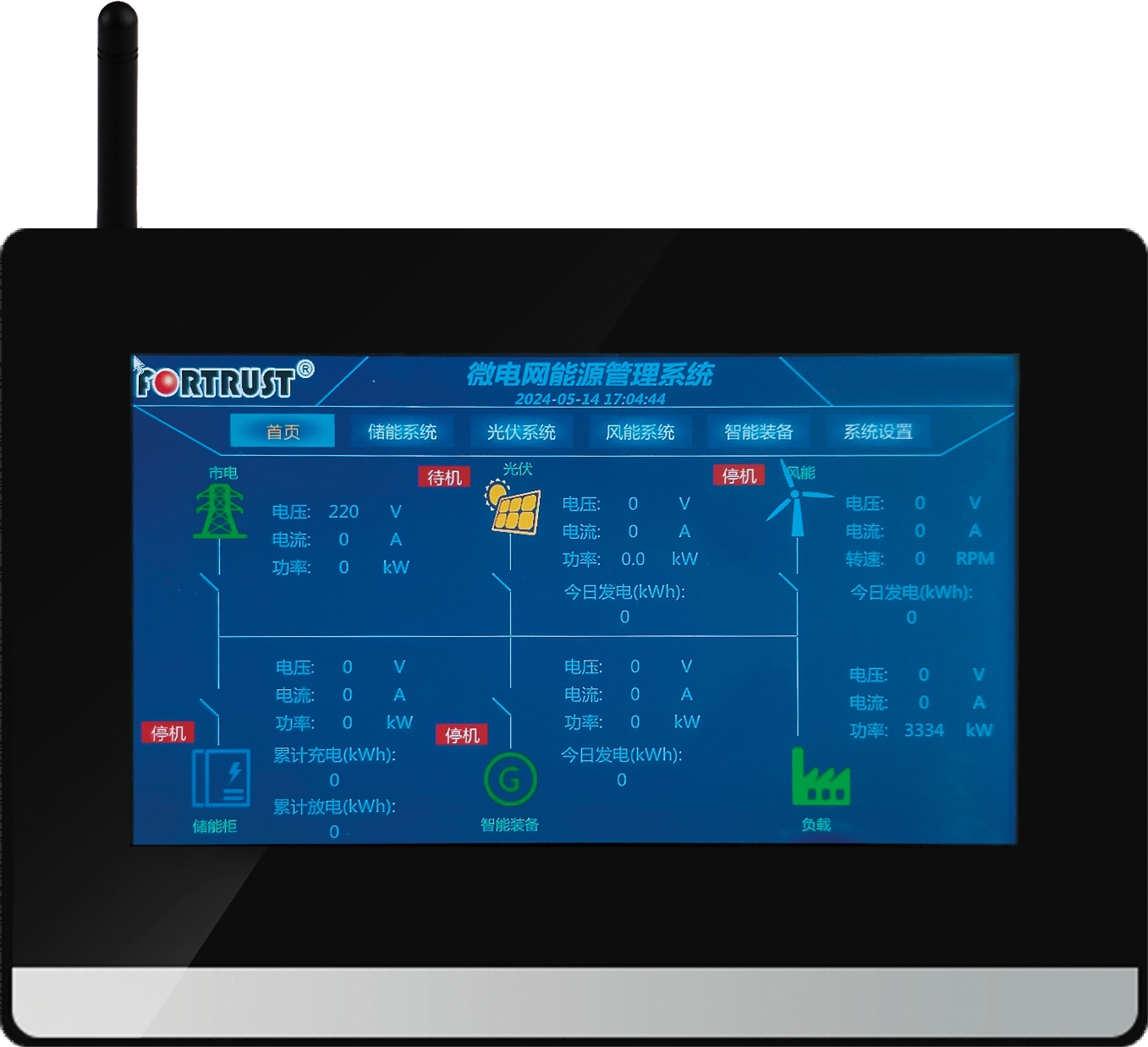
Adopting a quad-core Cortex®-A9 architecture, with a maximum clock speed of 1.4GHz, 1GB DDR3 memory, 8GB Flash, Linux system, 7-inch wide-temperature touchscreen, graphical data display, list-style data recording, and 32GB SD memory card; multiple communication interfaces: 3 isolated RS485 ports, 1 CAN port, 1 LAN port, WIFI, 4G interface, and 1 USB interface;
Diverse Control Strategies
Built in multiple control strategies, changing the traditional extensive power control method, fully utilizing intelligent scheduling algorithms to achieve energy scheduling among wind, solar, diesel, storage, and grid power, ensuring the reliability and stability of the system's power supply; achieving optimized control and management of multiple energy sources from an economic perspective;
Flexible Control Methods
Built-in multiple control modes, supports multiple communication protocols, and can receive dispatch commands from the power grid or other platforms;
Refined Control
Complete multi-communication interfaces, supports multiple communication protocols to collect data from wind turbine inverters, photovoltaic inverters, PCS, and generators, as well as equipment operating status and ambient temperature. It balances equipment output power from multiple dimensions, rationally formulates power control strategies, and improves the safety and economy of the microgrid system;
Complete Protection and Interlocking Functions
Real-time acquisition and judgment of the operating status and alarm information of various devices in the microgrid system, monitoring various anomalies; issuing frequency reduction, rating reduction, or shutdown commands based on equipment conditions, and performing interlocking and warnings;
Planned Operation Control
Grid Connection/Off-Grid Switching Control
Detects load conditions and grid connection point switch status, and issues commands to enable grid connection/off-grid switching for the energy storage PCS;
Black Start Voltage Support
In case of grid power outage or system failure; dispatch commands via CAN communication to control the generator to start and close the circuit breaker, providing busbar voltage support for photovoltaic, wind power, and energy storage, allowing the equipment to operate off-grid and supply power to the load;
Data Acquisition and Monitoring
It features monitoring and data acquisition capabilities for wind turbines, photovoltaics, energy storage batteries, SOC, SOH, power curves, PCS total charge and discharge, and load active power; data processing, alarm handling, human-machine interaction, and real-time statistics. It also includes fault alarms, parameter settings, data reports, curve display, and key detection information from application tools.
Anti-backflow power control
Real-time monitoring of load power and microgrid generation status; control of energy storage, generator, and wind power output; control of photovoltaic branch switching; and prevention of backflow of unabsorbed power back to the grid.



 中
中 英
英

![[Uniting for a Shared Future: Shipbuilding and Marine Engineering] Fuchuang Power Hosts and Deeply Participates in the Establishment of the Harbin Engineering University Alumni Shipbuilding and Marine Engineering Industry Alliance in Nantong](/uploads/upload/20260316/2603161FPGF.webp)